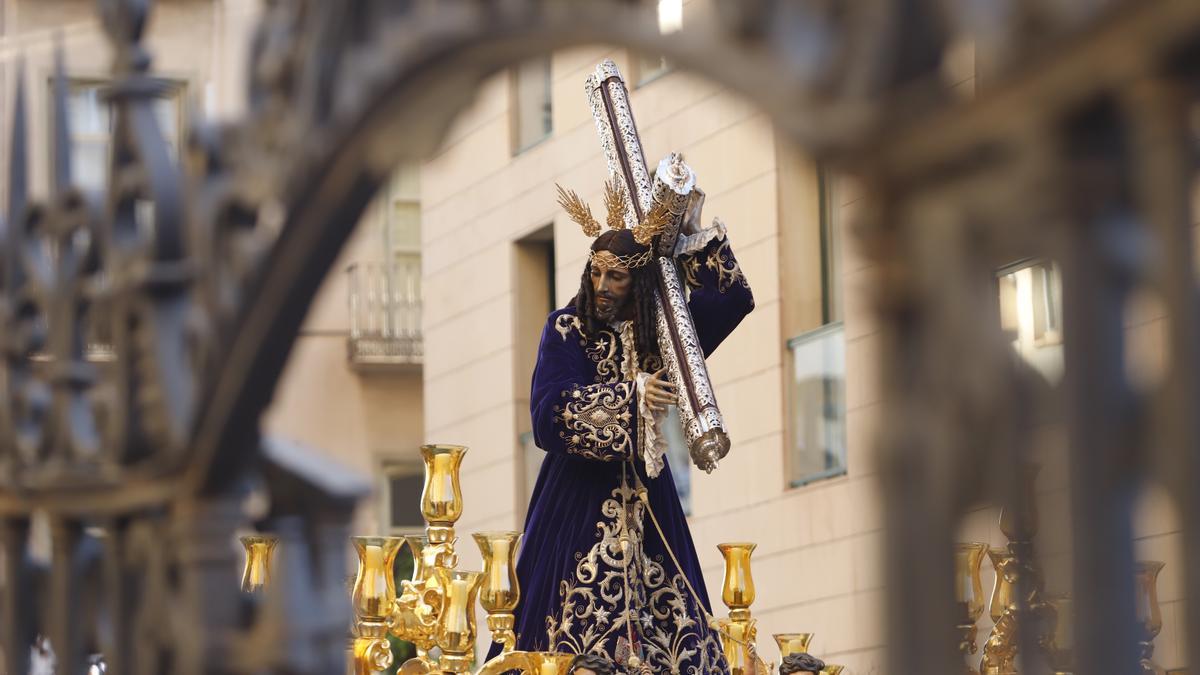
Holy Week in Málaga is a religious, social and cultural festival celebrated annually in the city with great pomp and devotion. This event, comprising 45 processions, offers a unique experience that completely transforms the atmosphere of the city.
At the heart of this celebration are the religious brotherhoods, some of which have a history dating back more than five centuries. These brotherhoods lead their patron images in procession from their places of origin along an official route through the historic centre; some even stop at the Cathedral during the penitential procession.
A distinctive feature of Holy Week in Málaga is the way the thrones are carried, using external poles that require the help of hundreds of people. Furthermore, the processions feature penitents, musicians, altar servers and military units, all of whom are essential elements of the event.
- Palm Sunday marks the start with nine processions, notably the iconic Pollinica brotherhood in the morning, followed by others such as Dulce Nombre, Humildad y Paciencia, Salutación, Ecce Homo, Salud, and the Virgen de Lágrimas y Favores in the afternoon.
- Holy Monday is marked by the main procession of Jesús Cautivo (with 4,100 members and 900 Nazarenes) from the Trinidad neighbourhood, accompanied by the popular brotherhoods of the Gitanos and the Estudiantes, as well as the Virgen de los Dolores del Puente.
- Holy Tuesday is characterised by the procession of the Virgin of El Rocío, known as ‘the Bride of Málaga’, alongside other traditional brotherhoods such as La Estrella, El Rescate and La Sentencia, as well as those of Las Penas and Nueva Esperanza.
- Holy Wednesday is distinguished by processions of a more traditional nature, such as those of the Cofradías Fusionadas, La Paloma, and Jesús ‘El Rico’ (in this brotherhood, a prisoner charged with minor offences is released during the procession, which takes place entirely in the Plaza del Obispo. The National Police also take part in this procession), ‘La Sangre’, and the sumptuous brotherhood of ‘La Expiración’ (the processions of La Expiración are among the most extensive of all the brotherhoods in Málaga. The participation of the Civil Guard also stands out as one of the distinctive features of their procession), as well as the Mediadora de la Salvación and the Salesianos.
- Holy Thursday is marked by the procession of La Esperanza, accompanied by others such as La Misericordia, Zamarrilla, La Sagrada Cena, Viñeros, the Congregación de Mena (the Congregación de Mena, whose full official name is the Pontifical and Royal Congregation of the Most Holy Christ of the Good Death and Souls and Our Lady of the Crowned Solitude, the Most Holy Christ of the Good Death is the patron and protector of La Legión, which is why the legion marches alongside the congregation on that Thursday evening) and the Vera Cruz, amongst others.
- Good Friday is characterised by processions setting out from various historic neighbourhoods, featuring brotherhoods such as La Victoria, La Malagueta, La Trinidad and El Molinillo, and others such as El Amor and Monte Calvario, the Descendimiento, the Soledad de San Pablo and the Piedad, as well as the iconic brotherhood of the Holy Sepulchre.
- Following a Holy Saturday without processions, Holy Week culminates on Easter Sunday with the procession of the Risen Christ, organised by the Association of Brotherhoods. Each brotherhood offers a unique spectacle at different locations around the city, such as processions and parades, crossing bridges, under the trees of the Alameda, along Calle Larios and at the Cathedral.
Holy
Week in Málaga is a true feast for the senses. Imagine walking through the streets whilst the scent of incense envelops you, mingling with the fragrance of fresh flowers. And let’s not forget the salty sea air, which also makes its presence felt. But it’s not just smells that fill the air; the atmosphere is charged with thrilling sounds: from the heavy footsteps of the processional floats to the processional marches that send shivers down your spine, not to mention the shouts of encouragement for the sacred images – all to the rhythm of bands playing music that touches your soul.
To round off, here’s the itinerary for these days of Passion in the city of Málaga, so you don’t miss a single memorable moment of this great tradition. SEE ITINERARY
If you’d like to experience it up close, take a look at our accommodation options in the city. CUBO’S HOLIDAY HOMES
As well as Malaga city centre, all the towns in the province host some fascinating events; the most notable towns are:
- Antequera:
Known as the city of El Torcal, it vigorously preserves its religious brotherhood traditions and boasts a rich cultural heritage. Among its unique features are the ‘hermanucos’, who carry the floats on their shoulders, secured with hairpins, during the processions. The statues are raised on spool-shaped pedestals on vertical thrones, with figures of Our Lady of Sorrows at the front, showcasing the characteristic Antequera style.
- Vélez-Málaga:
Holy Week, declared a Festival of National Tourist Interest, features nineteen Passion brotherhoods which carry out their penitential processions from Palm Sunday to Easter Sunday. Their processions date back to the 16th century.
- Archidona:
A great wealth of artistic heritage is preserved in the six brotherhoods that make up its Holy Week celebrations. The bell-ringers, dressed in tunics and scapulars, lead the processions to the rhythmic sound of their instruments. In addition, some brotherhoods maintain the Apostolate, a group of twelve members dressed in tunics, sandals, esparto grass belts and crowns of thorns, who carry crosses bearing the name of an apostle.
Traditionally, the Legion escorts the Cristo de la Misericordia, whilst the Civil Guard accompanies and escorts Nuestro Padre Jesús de la Humildad.
- Ronda:
Holy Week has its roots in the conquest of the city by the Catholic Monarchs and has been declared an Event of Andalusian Tourist Interest, featuring fifteen processions organised by fourteen brotherhoods. Unlike other cities, in Ronda the floats are carried by ‘costaleros’ or, in some cases, by ‘horquilleros’; of particular note is the Easter Sunday procession, where Our Lady of Loreto is carried exclusively by women.
- Río Gordo (the float):
The procession of the Río Gordo float, recognised as a Festival of National Tourist Interest, has taken place every Good Friday and Holy Saturday for over half a century. Although there is evidence to suggest it has existed since the 17th century, its current form was established in 1951, featuring a solemn and meticulous re-enactment.
More than 500 local amateur performers take part in this religious ceremony, which is held in an open-air venue.
- Alhaurín de la Torre:
Amongst many activities, on Good Friday, the Legion has a tradition of standing guard of honour for the Cristo de la Vera Cruz in the morning and escorting it in the afternoon during the procession.
- Alhaurín el Grande:
A very special moment in this religious celebration. The Brotherhood of Nuestro Padre Jesús Nazareno (known as ‘los moraos’) and the Confraternity of the Santa Vera Cruz (known as ‘los verdes’) come together to commemorate the Passion, Death and Resurrection of Jesus Christ. Among the highlights are the live re-enactment of the Passion of Jesus, as well as the meticulously organised processions that wind their way through the streets. The rich tradition of Holy Week in Alhaurín el Grande, and its significance for tourism, has been recognised nationally, with the festival being designated a Festival of National Tourist Interest in Andalusia.